
When people face legal problems, they often turn to search engines to understand their options. Someone dealing with a property dispute may search for information about property rights. A person facing a criminal allegation may look for information about bail procedures. Someone handling a family dispute may research applicable legal provisions and court processes.
These searches create an important connection between legal information, search engines and professional websites.
For law firms and advocates, having an accurate and accessible online presence can help people find relevant legal information and verify basic professional details. However, the legal profession in India operates under professional conduct requirements that distinguish informational website content from advertising and solicitation.
This makes Law Firm SEO different from SEO for ordinary commercial businesses.
Law Firm SEO involves improving the technical accessibility, organization and relevance of a legal website so that search engines can understand its information and users can find relevant resources. It may involve website structure, technical SEO, search intent research, content accuracy and local information management, but these activities must be considered alongside applicable professional restrictions.
In this guide, we explain what Law Firm SEO means, how search engines work with legal websites, what technical and content improvements matter, how to interpret actual campaign performance and why Indian advocates must pay particular attention to Bar Council of India Rule 36.
What Is Law Firm SEO?
Law Firm SEO is the process of improving a legal website’s search engine visibility, technical performance and information structure so that people can find relevant legal information and professional details through organic search.
It covers several connected areas:
- Legal keyword and search intent research.
- Practice area website architecture.
- On-page SEO.
- Technical SEO.
- Local search information.
- Legal content organization.
- Professional identity and information accuracy.
- Relevant website references and citations.
- Search performance measurement.
For example, people may search for:
- Criminal lawyer in Ahmedabad.
- Information about anticipatory bail.
- Property dispute legal procedure in India.
- Divorce procedure under applicable Indian law.
- Corporate legal compliance.
- Cybercrime investigation procedures.
- Legal rights after receiving a court notice.
These searches represent different information requirements. Some users want to understand a legal procedure, while others are trying to locate professional information relevant to their situation.
A well-organized legal website should make its information understandable, accessible and accurate.
An important distinction for Indian advocates: Better technical search visibility does not automatically mean that every promotional SEO activity is permitted. Rule 36 of the Bar Council of India Rules restricts direct and indirect advertising and solicitation. The limited website-information provision must also be considered.
What Does Law Firm SEO Include?
| SEO area | Purpose |
|---|---|
| Legal keyword research | Understand the language and questions used in legal searches |
| On-page SEO | Organize page titles, headings, descriptions and relevant content |
| Technical SEO | Improve crawling, indexing, mobile usability and website accessibility |
| Website architecture | Organize practice areas, professional information and legal resources |
| Local search information | Maintain accurate and relevant location information, subject to applicable rules |
| Legal content | Publish accurate, jurisdiction-specific educational information where permitted |
| Professional information | Present accurate qualifications and other permitted details |
| Link and citation management | Maintain relevant, accurate references without prohibited promotional practices |
| Performance measurement | Understand impressions, clicks, website sessions and other available metrics |
The objective is not simply to generate more website traffic. It is to make a legal website technically sound, understandable and useful while respecting the professional obligations of advocates.
Why Is SEO Relevant to Law Firm Websites?
People use search engines for different legal questions. A legal website that is difficult to navigate, poorly indexed or filled with outdated information may not serve those users effectively.
There are several reasons why search optimization deserves attention.
1. Help People Find Relevant Legal Information
Consider someone researching the procedure for obtaining anticipatory bail.
They may search for the relevant legal provision, procedural requirements, jurisdiction and court process. If a legal website contains a properly structured, accurate and accessible educational resource, search engines may be better able to understand and present that information.
This is an opportunity to improve information accessibility, not a reason to make exaggerated promises about legal outcomes.
2. Improve the Organization of Professional Information
A legal website may contain information about an advocate’s identity, enrolment details, qualifications and areas of practice.
Where publication is permitted under applicable professional rules, that information should be accurate, clearly organized and easy to locate.
Incorrect qualifications, outdated addresses or inconsistent professional details can create confusion.
3. Improve Website Accessibility
Technical SEO includes making sure that important pages can be discovered, crawled and indexed. It also involves improving mobile usability, page loading performance and navigation.
These improvements help people access the website more effectively, regardless of whether they arrive through Google Search, a direct link or another permitted source.
4. Maintain Accurate Legal Information
Legal provisions, procedural requirements and judicial interpretations can change.
A page that refers to outdated legislation without explaining its current status may mislead readers.
A structured legal content review process helps identify information that requires correction or updating.
5. Understand How People Discover Legal Information
Search Console data can help website owners understand which queries generate impressions and clicks.
For example, a legal website may receive impressions for searches involving criminal procedure, bail, cybercrime or property disputes.
Understanding these queries can help identify gaps in the website’s information structure.
This should be approached as search research and website improvement, not as an invitation to engage in prohibited solicitation.
How Does Law Firm SEO Work?
A legal website’s search performance depends on several connected factors. Search engines need to discover its pages, understand their subject matter and assess whether they are relevant to a user’s query.
Consider someone searching for information about a criminal procedure in Ahmedabad.
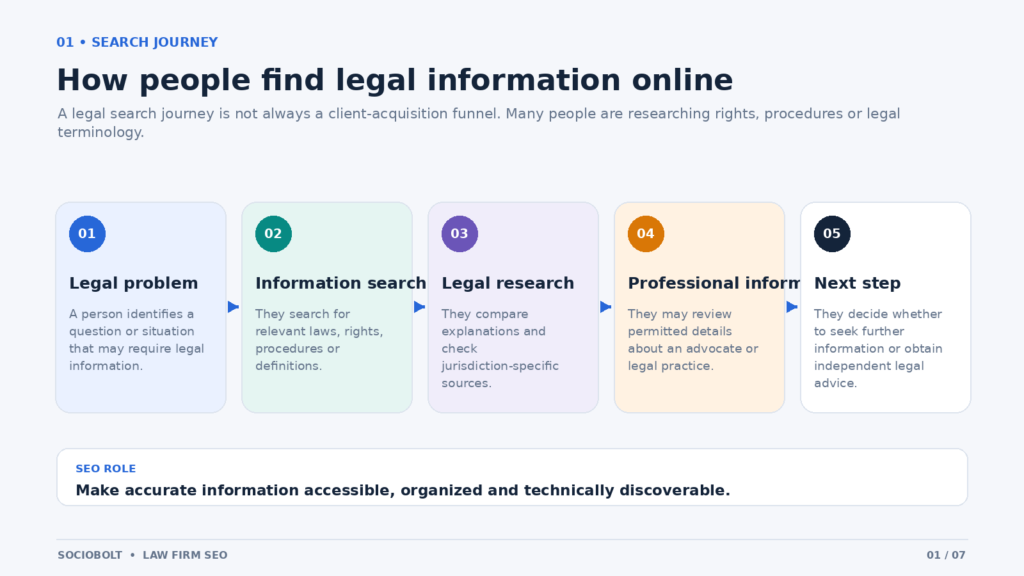
The search journey may involve several stages:
- The person identifies a legal problem.
- They search for general legal information.
- They investigate the applicable law and procedure.
- They look for relevant professional information.
- They review the available information and decide what steps to take.
A legal website can support this journey through accurate educational resources and properly organized professional information.
The Legal Search-to-Information Framework
Understanding Search Intent
Search intent refers to the purpose behind a search query.
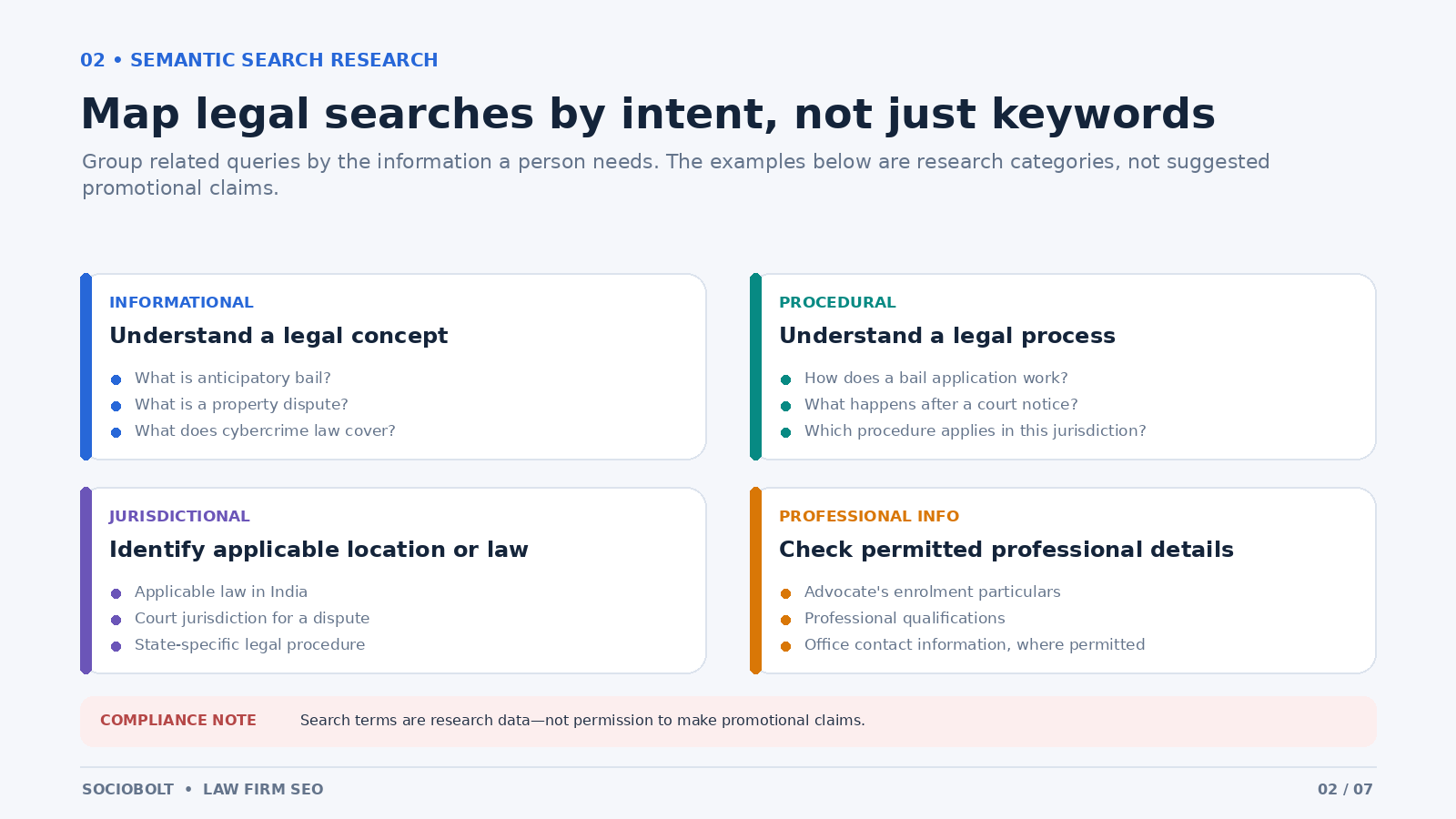
For legal websites, four broad categories are useful:
| Search intent | Example query | Suitable information |
|---|---|---|
| Informational | What is anticipatory bail? | Legal explanation and relevant provisions |
| Procedural | How does a bail application work? | Jurisdiction-specific procedural information |
| Professional information | Advocate in Ahmedabad | Permitted professional information |
| Local discovery | Lawyer near Ahmedabad court | Accurate location and professional information, subject to applicable rules |
The same broad legal subject can generate different queries.
For example, someone searching for the meaning of anticipatory bail needs an explanation of the legal concept. Someone searching for the applicable procedure needs more detailed procedural information.
Creating one generic page for every related query may not provide the best information experience.
What Are the Main Components of Law Firm SEO?
A structured approach combines technical optimization, content organization, information accuracy and performance measurement.
1. Legal Keyword Research and Search Intent
Keyword research helps identify the terms people use when looking for legal information.
However, legal keyword research should begin with subject matter and user requirements rather than a list of high-volume phrases.
For example, consider the subject of criminal law.
Related searches may include:
- Criminal law in India.
- Anticipatory bail procedure.
- Bail application process.
- Cybercrime provisions.
- Criminal investigation procedure.
- Rights of an accused person.
- Relevant court jurisdiction.
These terms belong to different informational and procedural contexts.
A practical research process includes:
- Identify the legal subjects relevant to the website.
- List common questions associated with each subject.
- Research the terminology used in search queries.
- Group related queries according to their meaning.
- Identify the most appropriate existing page for each topic.
- Check whether the information is current and jurisdiction-specific.
- Avoid creating repetitive pages simply to target minor keyword variations.
Real example: Criminal law searches in Ahmedabad
In an anonymized law practice campaign managed by SocioBolt, the supplied Google Business Profile search-term screenshot showed the following queries:
| Search term | Displayed count |
|---|---|
| best criminal lawyer in ahmedabad | 120 |
| criminal lawyer ahmedabad | 116 |
| criminal defense lawyer | 45 |
| criminal lawyer in ahmedabad | 46 |
| top 10 criminal lawyers in ahmedabad | 32 |
These figures illustrate the different ways people search around the same legal subject.
Some queries use city-specific terminology, while others use broader criminal defence terminology.
The data can help a website owner understand search language and subject relevance. However, the counts are Google Business Profile search-term figures, not unique users, website visits or confirmed enquiries.
Also, in India, phrases such as “best criminal lawyer” and “top criminal lawyer” raise an important professional compliance concern. Their appearance in search data does not mean advocates should use them as promotional website claims or advertising copy.
2. Practice Area Website Architecture
Legal websites often contain several areas of practice, professional information and educational resources.
Without a clear structure, important information can become difficult to locate.
A logical website architecture might look like this:
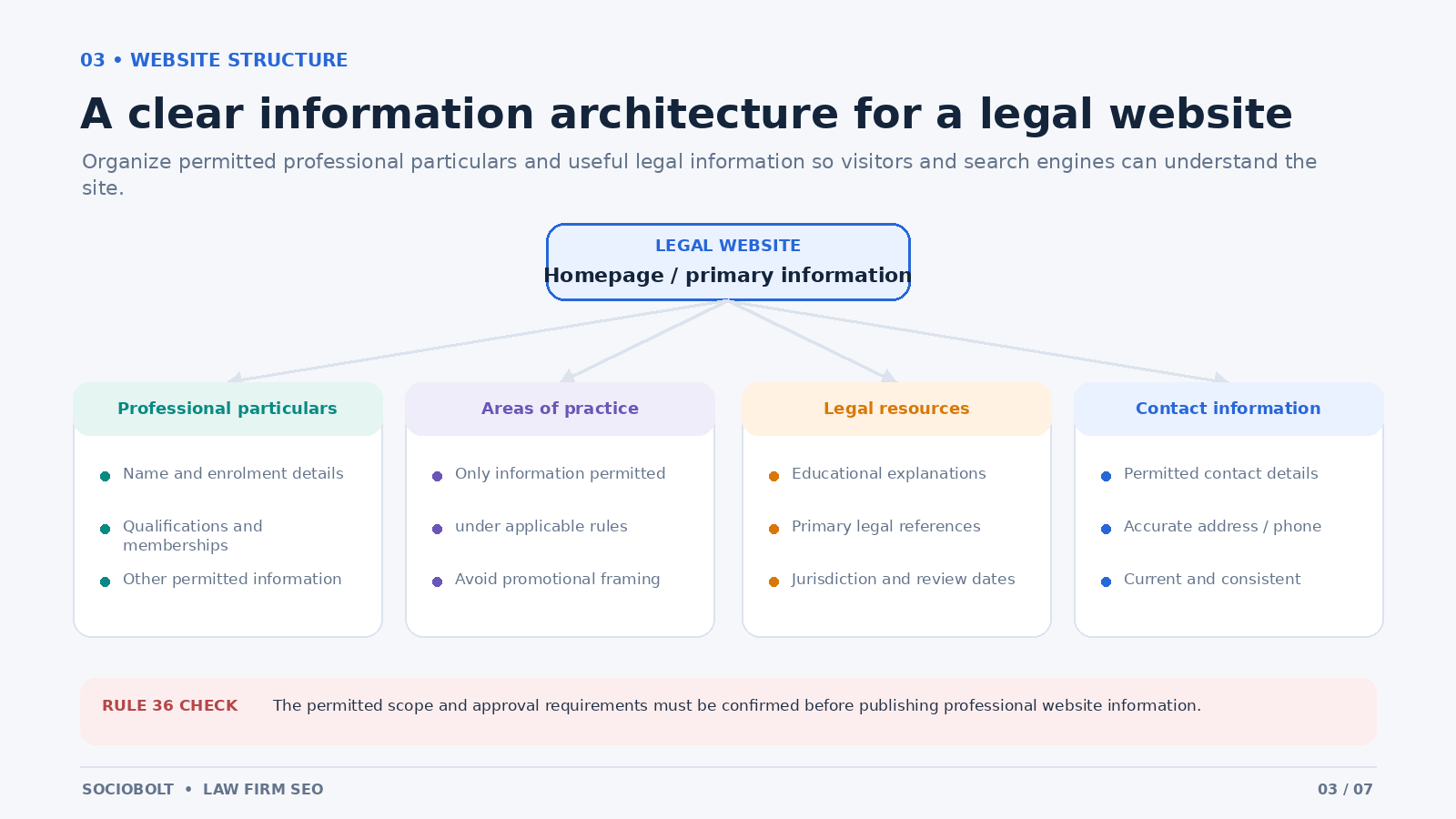
A possible structure includes:
- Main website information.
- Advocate’s permitted professional particulars.
- Areas of practice.
- Legal educational resources, where appropriate.
- Relevant legal references.
- Contact information as permitted under the applicable rules.
The exact content must follow the approved information requirements under Rule 36.
Avoid creating numerous near-identical pages for every city, locality or legal keyword. A website should have a clear information purpose rather than pages created only to capture search variations.
3. Technical SEO for Law Firm Websites
Technical SEO focuses on whether search engines can access and understand the website.
A legal website should be reviewed for:
Crawling and indexing
Check whether important pages can be accessed by search engine crawlers and whether the intended pages are eligible for indexing.
Website speed and Core Web Vitals
Review loading performance, responsiveness and visual stability. These measurements can identify usability problems that affect the website experience.
Mobile usability
Legal information should be readable on smartphones. Navigation, text size, page layout and contact details should work properly on smaller screens.
HTTPS and website security
A legal website should use HTTPS and maintain appropriate security practices.
Canonical URLs and duplicate content
Check whether multiple URLs display substantially similar content and whether canonical signals are correctly implemented.
XML sitemaps and robots.txt
Ensure that sitemaps identify the intended indexable pages and that robots.txt does not unintentionally block important resources.
Internal linking
Use descriptive internal links to connect related educational resources and relevant website sections.
These technical improvements help search engines process website information. They do not override professional conduct requirements governing what advocates may publish.
4. Local SEO and Google Business Profile
Local search can help users find relevant professional information associated with a geographical area.
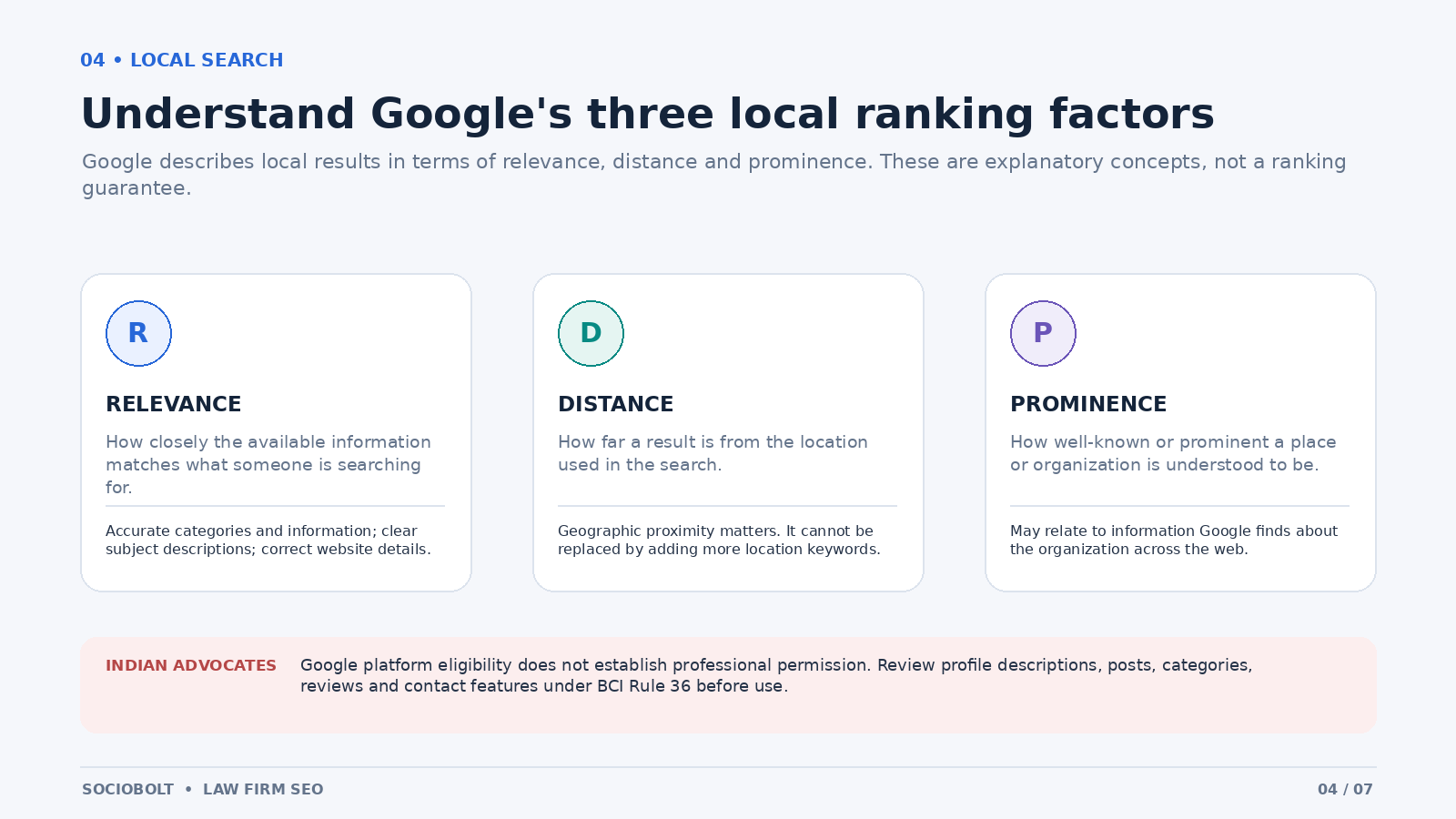
Google’s local ranking systems consider three main factors:
- Relevance.
- Distance.
- Prominence.
However, Indian advocates must exercise particular caution before treating Google Business Profile optimization as an ordinary lead-generation activity.
Rule 36 applies to direct and indirect advertising and solicitation. A Google Business Profile, its categories, descriptions, posts, promotional statements and associated contact mechanisms should not be assumed permissible simply because the platform provides those features.
A compliance-first review should consider:
- Whether the profile accurately represents the advocate or establishment.
- Whether the business representation is eligible under Google’s guidelines.
- Whether the information falls within the applicable permitted professional particulars.
- Whether any description or post amounts to promotion or solicitation.
- Whether the use of reviews, testimonials or comparative claims creates professional conduct concerns.
- Whether the profile and website contain consistent, accurate information.
A technical SEO provider should obtain appropriate professional guidance before implementing promotional profile activities for an Indian advocate.
5. Legal Content and Information Accuracy
Legal content requires particular attention because incorrect information can affect a person’s understanding of their rights and obligations.
A useful legal information page should have a clear subject, jurisdiction, relevant legal references and an identifiable review process.
For Indian legal websites, this may involve references to:
- Bharatiya Nyaya Sanhita, 2023.
- Bharatiya Nagarik Suraksha Sanhita, 2023.
- Bharatiya Sakshya Adhiniyam, 2023.
- Applicable central and state legislation.
- Relevant court judgments.
- Current procedural requirements.
For example, an educational resource about anticipatory bail should identify the relevant legal provision and explain its scope accurately. It should not make unsupported claims about guaranteed bail outcomes.
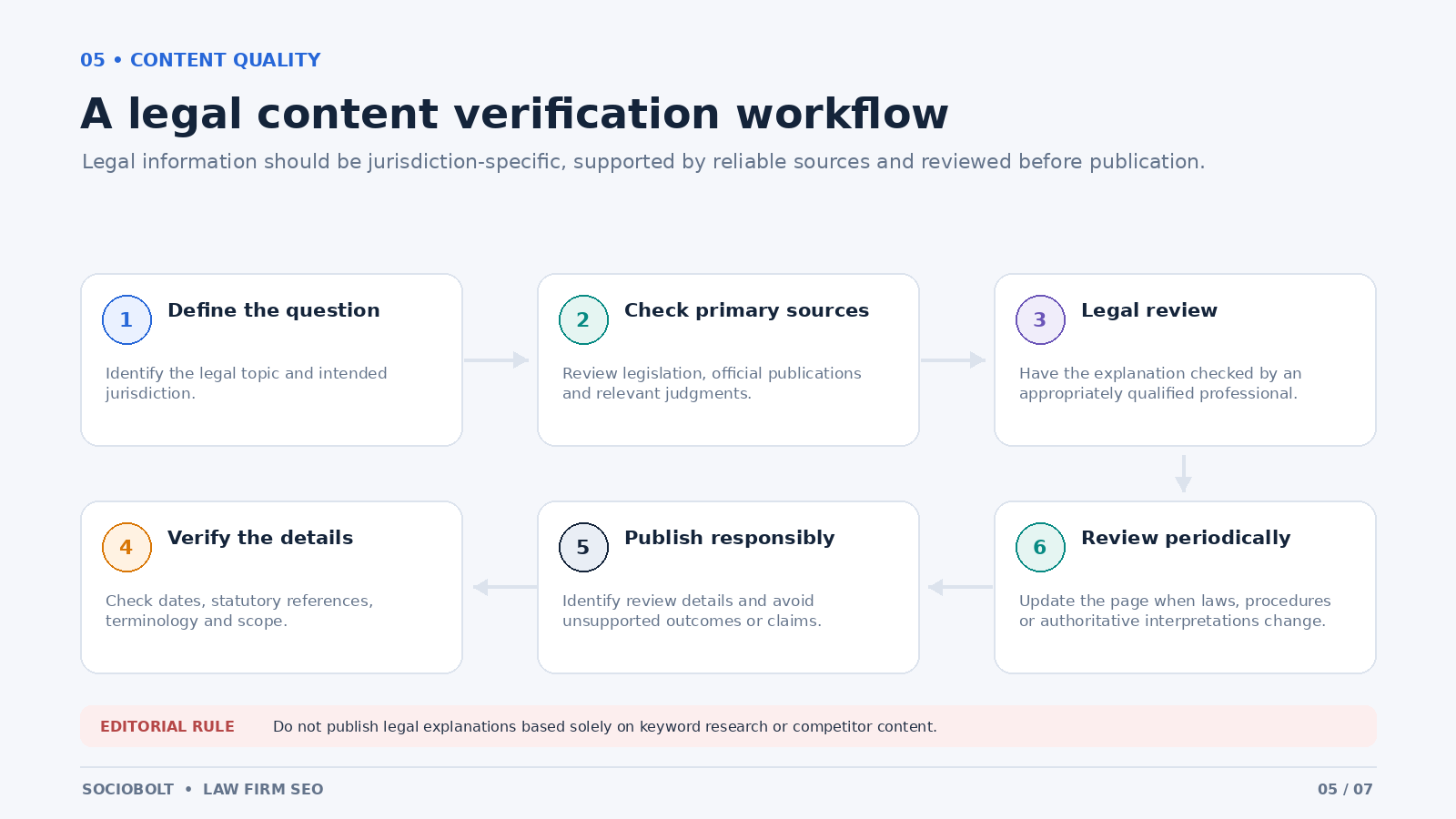
A good editorial process includes:
- Identify the applicable jurisdiction.
- Research primary legal sources.
- Verify the current statutory position.
- Check relevant judgments where necessary.
- Obtain review from an appropriately qualified legal professional.
- Include a publication or review date.
- Revisit the page when the law changes.
6. Professional Information and E-E-A-T
Google uses a range of signals to identify useful and trustworthy content.
Its E-E-A-T framework refers to Experience, Expertise, Authoritativeness and Trustworthiness. Google identifies trust as particularly important and explains that E-E-A-T itself is not a standalone ranking factor.
For legal information, accuracy and credibility deserve special attention.
A website should avoid:
- Invented professional credentials.
- Unverified qualifications.
- Incorrect enrolment details.
- Misleading experience claims.
- Unsupported statements about legal outcomes.
- Fake testimonials or fabricated case studies.
- Incorrect or outdated statutory references.
Where professional information is permitted, it should be accurate and consistent with the relevant Bar Council requirements.
7. Link and Citation Management
External references can help readers locate primary legal materials and authoritative information.
For example, an educational resource discussing legislation should reference the relevant official legal source wherever possible.
A legal website can also be reviewed for:
- Broken external references.
- Outdated legal citations.
- Incorrect government website links.
- Duplicate directory records.
- Inaccurate business details.
- Unnecessary or manipulative backlinks.
The focus should be on information quality and website integrity rather than backlink volume.
For Indian advocates, directory submissions, paid listings, promotional citations and third-party profiles require careful Rule 36 review. A directory accepting an advocate’s listing does not automatically make the listing professionally permissible.
8. Website Performance and Search Measurement
A website should be monitored using reliable analytics and search data.
The most useful starting points include:
Google Search Console
Measures search impressions, clicks, CTR, average position, search queries and indexing information.
Google Analytics 4
Measures website sessions, engaged sessions, traffic acquisition and configured events.
Google Business Profile Performance
Provides available profile visibility and interaction information.
These systems measure different things. A Search Console click is not necessarily the same as a GA4 session, and a Business Profile call action is not proof of a completed consultation.
A responsible reporting system should preserve these distinctions.
How to Build a Law Firm SEO Strategy Step by Step
A structured website improvement process makes it easier to identify issues, assign priorities and measure changes.
| Step | Activity | Deliverable |
|---|---|---|
| 1 | Website audit | Technical and content issue report |
| 2 | Search research | Legal query and topic map |
| 3 | Website architecture | Page structure and navigation plan |
| 4 | On-page review | Titles, headings and content organization |
| 5 | Technical optimization | Crawlability, indexing and mobile improvements |
| 6 | Local information review | Accurate and compliant business information |
| 7 | Content accuracy review | Legal source and review checklist |
| 8 | Citation review | Website and directory accuracy report |
| 9 | Performance monitoring | Search and website analytics report |
Example: Improving a criminal law information website
Consider a website associated with an advocate practising criminal law in Ahmedabad.
The website may have technical problems, unclear page organization and limited visibility for relevant legal information.
A structured improvement process could include:
Initial assessment: Review indexing, mobile usability, page structure and existing search performance.
Search research: Identify relevant criminal law terminology and informational queries.
On-page optimization: Improve the organization of permitted website information and relevant educational resources.
Technical SEO: Correct crawlability issues, indexing problems and broken internal links.
Information accuracy: Verify legal references and update outdated material.
Local information: Review the accuracy and professional permissibility of the website’s location and business information.
Measurement: Monitor impressions, clicks, sessions and other available metrics without treating every search interaction as a client enquiry.
The objective is a technically accessible and informative website that respects professional requirements.
Our Law Firm SEO Case Study: Organic Search Growth for a Criminal Law Practice
The following case study is based on performance screenshots and campaign information supplied for an Ahmedabad-based criminal law practice firm. The client’s identity is withheld.
The reporting period specified for this campaign is May–November 2026.
Campaign background
The practice initially received approximately 50 monthly organic visits, according to the campaign information supplied.
The objective of the SEO work was to improve the website’s technical health, on-page search relevance and local information consistency.
The activities confirmed as completed were:
- Local SEO and Google Business Profile optimization.
- On-page SEO and keyword optimization.
- Technical SEO.
- Citation and directory work.
The campaign did not rely on generic traffic growth alone. Its performance was reviewed using Google Analytics 4, Google Search Console and Google Business Profile reporting.
1. Monthly organic traffic progression
The supplied campaign information reports growth from approximately 50 monthly organic visits to more than 200 monthly organic visits.
50 → 200+ monthly organic visits
This represents at least a fourfold increase relative to the stated starting baseline.
It is important to distinguish this client-reported monthly traffic progression from the GA4 screenshot discussed below, which reports sessions across its displayed reporting period.
2. Google Analytics 4: Organic traffic contribution
The supplied GA4 traffic acquisition screenshot reports:
| Channel | Sessions | Engaged sessions | Engagement rate |
|---|---|---|---|
| Organic Search | 1,210 | 615 | 50.63% |
| Direct | 560 | 125 | 21.68% |
| Organic Social | 78 | 44 | 56.58% |
| Referral | 60 | 25 | 41.67% |
| AI Assistant | 17 | 6 | 35.29% |
| Unassigned | 10 | 1 | 10% |
| Total | 1,912 | 799 | 41.79% |
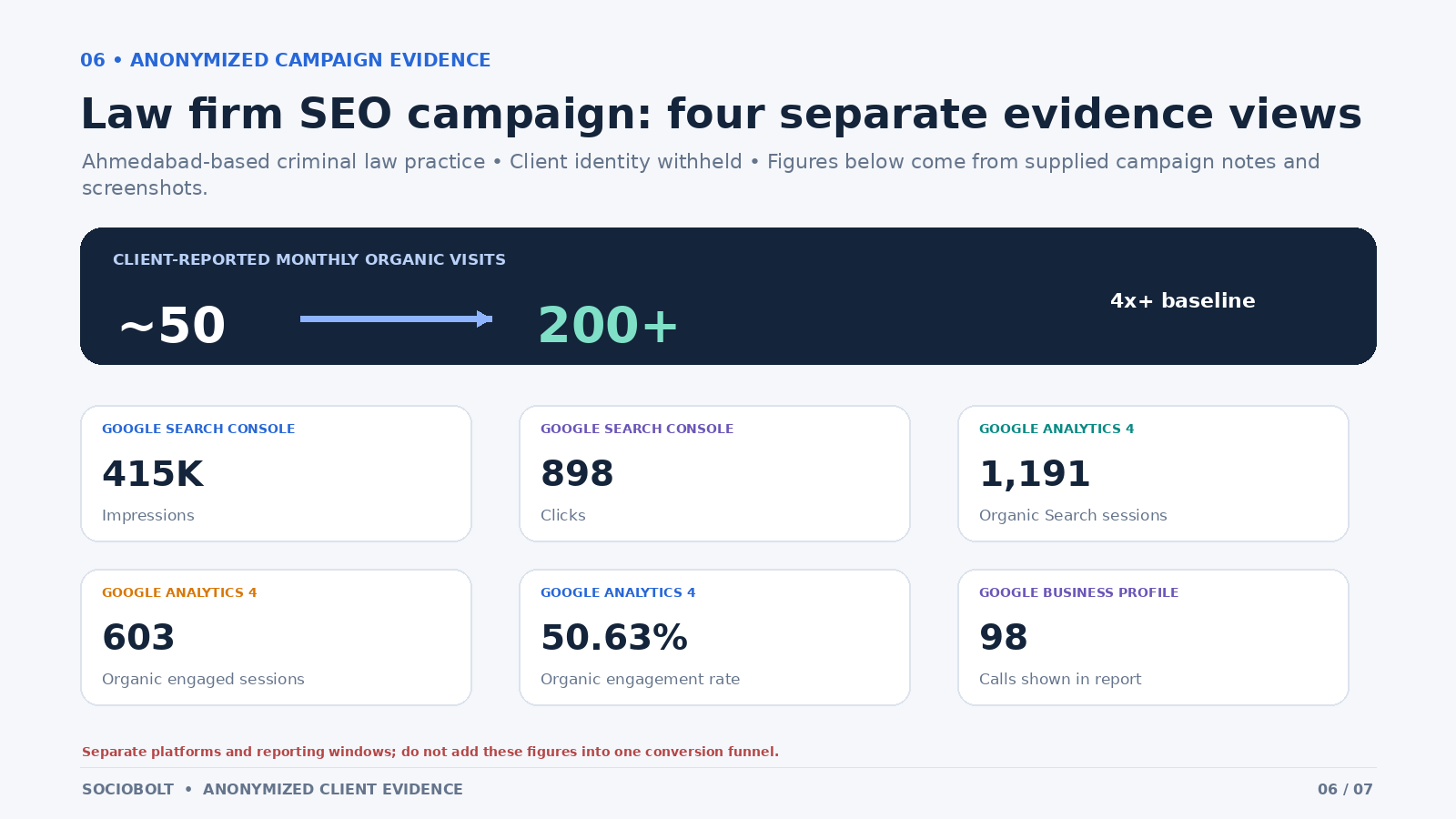
Organic Search accounted for 1,191 sessions, representing 62.29% of all reported sessions.
It also generated 603 engaged sessions, with a reported engagement rate of 50.63%.
For comparison, Direct traffic generated 558 sessions and had an engagement rate of 21.68%.
This indicates that Organic Search was an important website traffic source during the displayed reporting period.
However, engaged sessions should not be interpreted as qualified legal enquiries. GA4 engagement measures website interaction according to its event and engagement definitions, not whether someone became a client.
3. Google Search Console: Organic visibility
The supplied Search Console screenshot reports:
| Metric | Result |
|---|---|
| Total clicks | 898 |
| Total impressions | 415,000 |
| Average CTR | 0.2% |
| Average position | 8 |
The website generated 415,000 search impressions and 898 clicks during the displayed reporting period.
The reported average position was 8, while the displayed CTR was 0.2%.
This provides an important lesson about search performance.
A website can generate substantial impressions without achieving the same level of clicks. Search appearance, query relevance, title presentation and the type of information offered can all influence whether a user selects a result.
The average position is an aggregate metric, not a guarantee that every search term ranked eighth.
The displayed CTR is also rounded, so the screenshot’s 0.2% figure should be retained rather than replaced with an inferred value.
4. Google Business Profile: Search discovery
The supplied Business Profile screenshot identifies these five search terms:
| Search term | Displayed count |
|---|---|
| best criminal lawyer in ahmedabad | 123 |
| criminal lawyer ahmedabad | 114 |
| criminal defense lawyer | 45 |
| criminal lawyer in ahmedabad | 44 |
| top 10 criminal lawyers in ahmedabad | 38 |
These terms reveal how people searched for criminal law-related professional information.
They include city-specific searches, broader criminal defence terminology and comparative phrases.
This data is useful for understanding search language and local discovery patterns.
However, these figures are not unique users, website visits or confirmed legal enquiries. The screenshot also does not establish that every displayed search led to a profile interaction.
For Indian advocates, these search terms must not be converted into promotional claims such as “best criminal lawyer” or “top criminal lawyer” without considering Rule 36.
5. Google Business Profile: Call activity
The supplied Business Profile calls screenshot reports:
98 calls made from the Business Profile.
The displayed graph covers June–November 2026, with the highest shown monthly activity around September.
The figure of 98 represents calls made from the Business Profile according to the screenshot. It should not be presented as 98 new clients, 98 qualified legal matters or 98 signed engagements.
The distinction matters because a call action does not establish what happened after the call.
What does this campaign demonstrate?
The anonymized campaign illustrates four different dimensions of digital search performance:
| Measurement area | Evidence |
|---|---|
| Monthly organic traffic progression | Approximately 50 to 200+ monthly visits, as reported for the campaign |
| Website traffic contribution | 1,191 GA4 Organic Search sessions |
| Search visibility | 415K impressions and 898 Search Console clicks |
| Business Profile interaction | 98 reported calls |
These metrics come from different reporting systems and may have different measurement windows. They should not be added together or represented as one conversion funnel.
The campaign demonstrates why a law firm’s digital performance assessment should consider search visibility, website engagement and available contact activity separately.
It also illustrates the importance of measuring what can actually be supported by the data.
Case study attribution: Campaign activities and performance figures are based on information and screenshots supplied for an anonymized SocioBolt client project. The results are specific to this project and are not a promise of similar outcomes for other practices.
Common Law Firm SEO Mistakes to Avoid
1. Targeting keywords without understanding their meaning
Legal searches can have different meanings depending on jurisdiction, procedure and context. Keyword selection should consider the actual information requirement.
2. Publishing outdated legal information
Old statutory references, outdated procedures and superseded legal interpretations can mislead readers.
3. Creating duplicate practice area pages
Changing only a city or locality name across multiple pages does not provide meaningful additional information.
4. Ignoring technical website issues
A website may contain useful information but still have indexing, mobile usability or navigation problems.
5. Publishing unsupported professional claims
Unverified qualifications, misleading experience claims and promotional comparisons create professional and credibility risks.
6. Treating all traffic as potential clients
Organic sessions, engaged sessions, phone actions and actual legal engagements are different measurements.
7. Ignoring Rule 36
Indian advocates must not assume that ordinary digital marketing tactics are permissible simply because they are available on search platforms.
8. Buying irrelevant backlinks or directory listings
Mass submissions and paid promotional listings can create search quality and professional conduct concerns.
How to Measure Law Firm SEO Performance
A useful SEO report should separate search visibility from website behaviour and professional contact activity.
| Measurement category | Metrics |
|---|---|
| Search visibility | Impressions, search queries and average position |
| Search engagement | Clicks and CTR |
| Website traffic | Organic sessions and users |
| Website engagement | Engaged sessions and engagement rate |
| Technical health | Indexing, crawlability and Core Web Vitals |
| Local discovery | Available Business Profile performance metrics |
| Contact activity | Permissible and appropriately configured contact actions |
| Business outcomes | Properly recorded enquiries and engagements, where lawfully measurable |
Tools for monitoring performance
Google Search Console: Use it to understand which queries generate impressions and clicks, which pages appear in search and whether indexing problems exist.
Google Analytics 4: Use it to monitor traffic acquisition, engaged sessions and configured website events.
Google Business Profile: Review available performance information, while ensuring the profile’s use complies with applicable professional requirements.
Technical SEO tools: Use appropriate crawling, performance and website audit tools to identify indexing, mobile usability and site architecture issues.
The reporting process should answer three questions:
- Is the website technically accessible and properly indexed?
- Are people finding relevant information through search?
- Are the available website and contact measurements being interpreted accurately?
This creates a more reliable view of performance than reporting keyword positions alone.
How Long Does Law Firm SEO Take?
There is no fixed timeline for SEO results.
The time required depends on the website’s history, technical condition, competition, content quality, indexing status and the scope of improvements.
Technical corrections may be implemented relatively quickly, while changes in competitive search visibility can take longer.
For a legal website, the priority should be to establish a baseline, identify technical and information gaps, implement improvements and monitor performance consistently.
No SEO provider can responsibly guarantee a specific Google ranking or a fixed number of legal enquiries.
How to Choose a Law Firm SEO Agency
When evaluating an SEO provider, legal practices should look beyond ranking promises and monthly traffic estimates.
Consider the following questions:
| Evaluation area | What to check |
|---|---|
| Technical SEO | Does the agency conduct proper website audits? |
| Search research | Does it understand legal search intent? |
| Website architecture | Can it identify structural and navigation issues? |
| Content quality | Does it understand the importance of legal accuracy? |
| Local SEO | Does it understand local search and platform requirements? |
| Professional compliance | Does it recognize Rule 36 and advocate conduct restrictions? |
| Reporting | Does it distinguish impressions, clicks, sessions and contact actions? |
| Transparency | Are campaign activities and limitations clearly explained? |
How SocioBolt Approaches SEO
SocioBolt’s broader SEO methodology includes keyword and search intent research, on-page optimization, technical SEO, content optimization, local SEO, ethical link acquisition and performance monitoring.
Its published services emphasize data-driven reporting and the distinction between website traffic and meaningful commercial outcomes.
For legal websites in India, however, the strategy must begin with a professional compliance review. Technical website improvements, information organization and analytics should not be confused with permission to advertise or solicit legal work.
You can read more about SocioBolt’s Local SEO services and broader digital marketing capabilities.
Bar Council of India Rule 36: What Advocates Should Know About Online Visibility
This is an essential consideration for Indian law firms and advocates.
Under Rule 36 of the Bar Council of India Rules, an advocate shall not solicit work or advertise, directly or indirectly.
The restriction covers forms of advertising and solicitation such as advertisements, touts, certain personal communications, interviews not warranted by personal relations, and publicity connected with cases in which the advocate has been engaged or concerned.
What does the website-information exception permit?
Rule 36 contains a proviso relating to advocates furnishing website information in accordance with the prescribed Schedule, under intimation to and as approved by the Bar Council of India.
The Schedule includes specified professional particulars such as:
- Name.
- Address.
- Telephone numbers.
- Email address.
- Enrolment number and relevant enrolment information.
- State Bar Council details.
- Bar Association membership.
- Professional and academic qualifications.
- Areas of practice.
- A declaration concerning the truth of the information.
The rule states that additional particulars beyond those approved can be treated as a violation and may lead to professional misconduct proceedings under Section 35 of the Advocates Act, 1961.
The important point is that this is a limited website-information provision, not general permission to advertise legal services.
What did the Government clarify in August 2024?
In its written response to a Lok Sabha question on 9 August 2024, the Ministry of Law and Justice stated that the prohibition on direct and indirect advertising and solicitation by advocates under Rule 36 remained in place.
The response also referred to the Bar Council of India’s July 2024 directives concerning enforcement against online platforms facilitating prohibited advertising and solicitation.
This reinforces why digital marketing activities for Indian advocates require careful professional review.
What does this mean for SEO?
SEO is a broad technical and content discipline. Some activities improve website accessibility and information accuracy, while others may become promotional or solicitational depending on their implementation.
For example:
| Activity | Compliance consideration |
|---|---|
| Fixing broken links | Technical website maintenance; generally distinct from promotion |
| Improving mobile usability | Technical website improvement |
| Correcting indexing problems | Technical SEO |
| Organizing permitted professional particulars | Must follow Rule 36 and the approved Schedule |
| Publishing promotional claims | Requires particular caution and may violate Rule 36 |
| Using testimonials or comparative claims | Must not be assumed permissible |
| Paid advertisements for legal services | Significant Rule 36 concern |
| Promotional directory listings | Must be assessed for direct or indirect solicitation |
| Google Business Profile promotional content | Must be reviewed against professional restrictions |
| Publishing educational legal material | Requires legal and professional conduct review; do not assume a blanket exemption |
This table is an editorial risk guide, not a legal determination that a particular digital activity is permitted or prohibited in every situation.
A compliance-first approach for Indian advocates
Before implementing a digital strategy:
- Review the current Bar Council of India Rules.
- Identify the exact professional particulars permitted for website publication.
- Confirm the applicable intimation and approval requirements.
- Have proposed website content reviewed by an appropriately qualified professional.
- Assess Google Business Profile information and third-party directory use separately.
- Avoid unsupported promotional statements, testimonials and solicitation mechanisms.
- Maintain accurate professional information.
- Obtain current professional guidance where the rules or their application are uncertain.
For legal practices, professional compliance should be part of the website planning process, not a final check after publication.
Frequently Asked Questions About Law Firm SEO
1. What is Law Firm SEO in simple terms?
Law Firm SEO means improving the technical structure, information organization and search visibility of a legal website so people can find relevant legal information and professional details through search engines.
2. How does SEO help a legal website?
SEO can help search engines discover and understand a legal website’s information. It can also improve navigation, indexing, mobile usability and the accessibility of relevant educational resources.
3. What is the difference between Lawyer SEO and Local SEO?
Lawyer SEO refers broadly to search optimization for legal websites. Local SEO focuses on geographically relevant search information, business details and local discovery. For Indian advocates, local optimization must also be considered under Rule 36.
4. Which keywords should legal websites target?
Keyword research should focus on relevant legal subjects, statutory terminology, procedural questions and jurisdiction-specific searches. Keywords should be mapped to accurate and useful information rather than selected solely for search volume.
5. Does every legal practice area need a separate page?
A clearly organized website can have separate information sections for distinct practice areas where publication is professionally permissible. The content must follow the applicable website-information requirements and should not be used as disguised advertising.
6. How important is technical SEO for law firm websites?
Technical SEO helps search engines crawl and index website pages. It also addresses mobile usability, site structure, HTTPS, broken links and page performance.
7. Can Indian advocates use Google Business Profile?
Google Business Profile is a platform for eligible businesses and organizations, but eligibility under Google’s policies does not establish compliance with professional conduct rules. Advocates should obtain appropriate professional guidance before using profile features or promotional information.
8. Can Indian advocates advertise through SEO?
Rule 36 prohibits advocates from soliciting work or advertising directly or indirectly. The limited website-information provision does not create general permission for SEO-based advertising or solicitation. Each proposed activity should be reviewed against the current rules.
9. How long does Law Firm SEO take?
There is no fixed timeline. Results depend on the website’s condition, technical issues, competition, content quality and the work required. Performance should be evaluated using consistent reporting periods.
10. How can law firms measure SEO performance?
Google Search Console can measure search impressions and clicks. Google Analytics 4 can measure website sessions and engagement. Other contact and business measurements should be kept separate and interpreted accurately.
11. Is legal blogging useful for search visibility?
Accurate legal educational resources may help users understand relevant legal subjects and help search engines understand a website’s information. However, advocates must ensure that the publication and presentation comply with Rule 36 and other applicable professional requirements.
12. What should a law firm look for in an SEO agency?
A suitable provider should understand technical SEO, search intent, website architecture, legal information accuracy, transparent reporting and the professional restrictions applicable to the legal practice.
Conclusion: A Responsible Approach to Law Firm SEO
Law Firm SEO is more than improving keyword positions or generating website traffic. It involves making legal information accessible, organizing professional website details, maintaining technical website health and understanding how people discover relevant legal resources.
For Indian advocates, these activities must be approached with particular care because Rule 36 of the Bar Council of India Rules restricts direct and indirect advertising and solicitation.
A responsible strategy therefore starts with professional compliance, followed by technical website improvements, accurate information organization and transparent search performance measurement.
The SEO campaign for law firm illustrates why these measurements should be considered separately. The supplied evidence shows an increase from approximately 50 to more than 200 monthly organic visits, 415,000 Search Console impressions, 1,191 GA4 Organic Search sessions and 98 Google Business Profile calls. Each metric provides a different view of website or search activity; none should automatically be interpreted as a confirmed legal engagement.
For organizations seeking technical SEO expertise, SocioBolt combines website audits, search intent research, on-page optimization, local search expertise and performance monitoring. For Indian advocates, any proposed implementation should first be assessed against applicable professional conduct requirements.
Explore SocioBolt’s SEO and digital marketing capabilities to understand its technical approach to website optimization and search performance.